- Sharing information with arbitrators on recent decision quality trends and drivers.
- Answering questions arbitrators may have on hearing cases.
Deferments & Deferment Challenges
Any company may add a one-year deferment. (Rule 2-10, page 52 of the Reference Guide to Arbitration Forums, Inc.’s Agreements and Rules).
- The reason for the deferment must be explained in the Deferment Justification section, and any supporting evidence should be attached.
- There is no fee for an initial deferment.
If challenged, an arbitrator will consider the validity of the deferment.
Proving Damages
The burden of proof is equal between all companies.
- The burden does not shift to the responding company because a damage dispute has been raised.
- The recovering company must establish a prima facie case when seeking damages.
- The responding company(ies) must support their damage arguments.
- When the responding company supports their dispute, the recovering company, through their rebuttal and/or supporting evidence, should refute the dispute and substantiate their damages.
The most common types of word versus word losses include:
- Lane changes
- Light disputes
- Arbitrators should remember they are not adjusting the claim.
- Arbitrators may apply their claims knowledge.
- Comparative negligence may apply to these types of losses.
When the responding company files a counter feature and selects “Salvage Pending,” the system will recommend submitting a deferment request if one or more companies have not yet responded, even if policy limits have not been raised.
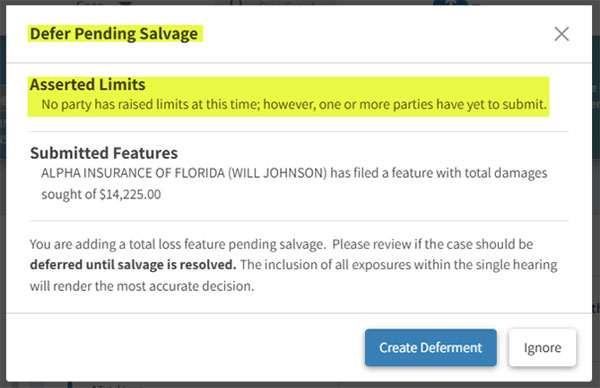
- If this type of deferment has been requested and subsequently challenged, the arbitrator would need to review the arguments and supporting evidence presented to verify if a deferment is necessary. Relevant arguments may include multiple parties, the possibility of additional exposures, salvage sale resulting within the policy limit amount, or an opportunity to accept policy limits and pro-rata share upon the salvage sale.
- When there is salvage pending and a potential policy limits issue exists, it is advisable to have all features heard together so that a pro-rata distribution of policy limits can be applied when appropriate.
- If these criteria are met, the arbitrator may allow the deferment.
Prior Payment Evidence
Prior payment evidence is not required to be attached to the damages section in order to be considered. The prior payment evidence may be attached anywhere within the filing.
However, to apply the credit, the responding company must still allege the payment in the payment section.
Rental Damages
A repair estimate is not required to prove rental damages. Other types of evidence may be used to substantiate rental damages incurred, including:
- Adjuster’s notes
- Body shop notes
- Vehicle photos
Arbitration decisions must be made solely by the arbitrator based on the facts presented and the applicable law. As reflected in AF’s Neutrality Statement, decisions must be grounded in the arbitrator’s own understanding of the law and evaluation of the evidence.
Our next arbitrator workshop will be held on August 25 and August 27 at 2 p.m. ET. Enroll today. We hope to see you there!